Date April 27, 2026
Category
You step into your yard one morning, coffee in hand, and notice something unsettling: large strips of bark curling away from your favorite shade tree. Your first instinct is worry, and understandably so. Tree bark peeling is one of the most common concerns that DFW homeowners call us about at TreeNewal, especially during the transitional months of spring and fall when temperature swings stress trees in ways that are hard to predict. The good news? Peeling bark does not always mean your tree is dying. In many cases, it is a perfectly natural process. But in others, it signals disease, pest damage, or environmental injury that requires prompt attention. In this guide, our team of ISA Certified Arborists breaks down the causes of tree bark peeling, explains when you should be concerned, and outlines the steps you can take to protect the trees on your North Texas property.
When Bark Peeling Is Completely Normal
Before you panic, it helps to know that many tree species shed their bark as part of a healthy growth cycle. Think of it the way a snake sheds its skin: the tree outgrows its outer layer and replaces it with fresh bark underneath.
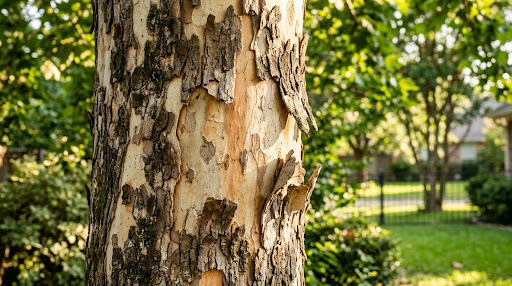
Several species that thrive in the Dallas-Fort Worth area are well known for this behavior. Crepe Myrtles develop their signature smooth, mottled trunks precisely because they exfoliate their outer bark every year. Sycamores shed large, puzzle-piece-shaped plates of bark to reveal creamy white inner wood, a trait so distinctive that it is often used to identify the species from a distance. Birch trees peel in papery sheets, while cedar elms frequently drop small flakes throughout the growing season.
Seasonal timing also plays a role. Many trees shed bark more actively during spring and early summer when rapid growth expands the trunk diameter. The older, outer bark simply cannot stretch fast enough and cracks away. This growth-related bark expansion is entirely normal and usually reveals healthy, green or light-colored tissue underneath.
A quick rule of thumb: if the wood beneath the peeling bark looks smooth and healthy (green, tan, or creamy white), and the tree’s canopy is full with no signs of dieback, the shedding is almost certainly a natural process. No treatment is needed.
When Bark Peeling Is a Warning Sign
Not all bark loss is benign. When the tissue beneath exposed bark appears dark, mushy, dry, or riddled with holes, something more serious may be at play. Here are the most common culprits our ISA Certified Arborists encounter in North Texas.
Sunscald: The south-and-west-facing sides of a tree trunk suffer from direct exposure from the sun. The result is vertical cracks and strips of dead bark that peel away, along with wood-boring insect infestations. Young trees and thin-barked species like red maples are especially vulnerable.
Fungal infections: canker-causing fungi such as Hypoxylon and Botryosphaeria attack stressed trees and destroy bark tissue from the inside out. If you notice dark, sunken areas on the trunk or large sections of bark falling away to reveal black or powdery wood beneath, a fungal infection is likely. TreeNewal’s team frequently diagnoses Hypoxylon canker on post oaks and other hardwoods across DFW, particularly after prolonged drought.
Pest infestation: Bark beetles bore into the cambium layer just beneath the bark, leaving telltale sawdust-like frass and tiny entry holes. Heavy infestations weaken the bark’s attachment to the trunk, causing large sections to slough off. Southern pine beetles and elm bark beetles are both active in North Texas.
Mechanical damage: Lawn mowers, string trimmers, and even construction equipment can gouge bark at the base of a tree. These wounds rarely heal cleanly and often invite secondary infections. Cankers may form around the wound margin, leading to progressive bark loss over months or years.
Common Causes of Tree Bark Falling Off in North Texas
Living in the Dallas-Fort Worth metroplex means your trees face a unique set of stressors that homeowners in other regions rarely encounter.
Extreme heat cycles. North Texas summers routinely push past 100 degrees Fahrenheit, and surface temperatures on south-facing bark can climb even higher. Sustained heat bakes moisture out of bark cells, leaving them brittle and prone to cracking. When cooler weather finally arrives, the damaged bark separates from the trunk.
Drought stress. Water-deprived trees redirect resources away from bark maintenance and toward keeping roots and foliage alive. Over time, the neglected outer bark dries out and peels.
Drought also makes trees far more susceptible to opportunistic pathogens like Hypoxylon canker and root rot, compounding the problem.
Late freezes. DFW’s unpredictable spring weather is notorious for delivering hard freezes well into March, just when trees have begun pushing new growth. The sudden cold damages tender bark tissue and can cause frost cracks that do not become visible until weeks later.
Construction damage. Rapid development in cities like Southlake, Flower Mound, Trophy Club, and Argyle means heavy equipment operating near established trees. Soil compaction, root severing, and direct trunk strikes all contribute to tree bark falling off, sometimes long after the construction crew has left. If your neighborhood is experiencing new builds, keep a close eye on nearby mature trees.
How to Assess Your Tree’s Bark Damage
If you notice bark peeling on one of your trees, a quick visual inspection can help you determine whether the issue is cosmetic or serious.
Start by examining the color of the wood beneath the missing bark. Healthy tissue is typically green, cream, or light tan. Dark brown, black, or powdery surfaces suggest disease or decay.
Next, consider the extent of the loss. A few small patches on a large trunk are usually manageable. But if more than a third of the trunk’s circumference has lost its bark, the tree’s ability to transport water and nutrients is compromised.
Look upward for branch dieback directly above the damaged area. Dead limbs with no leaves or leaves that wilted prematurely are a strong indicator that the bark damage has disrupted the vascular system. Finally, check for boring dust (fine, sawdust-like material) around the base of the trunk or in bark crevices. Tiny round holes roughly the diameter of a pencil lead confirm bark beetle activity.
Document what you find with photos and notes. This information is invaluable when you share it with an arborist, as it speeds up the diagnostic process significantly.
When to Call an ISA Certified Arborist
While minor, natural bark shedding can be left alone, certain symptoms warrant a professional evaluation. Contact an ISA Certified Arborist if you observe any of the following: large sections of bark separating from the trunk, dark or foul-smelling wood beneath the bark, visible fungal growth (mushrooms or conks) at the base or along the trunk, boring holes or sawdust on or around the tree, significant branch dieback above the damaged zone, or cracks that extend deep into the heartwood.
At TreeNewal, our ISA Certified Arborists serve homeowners across Southlake, Keller, Colleyville, Grapevine, Flower Mound, Denton, Fort Worth, Dallas, and the surrounding communities. We use a science-based approach to diagnose bark issues accurately, whether the cause is environmental stress, disease, or pest activity. Early intervention can often save a tree that might otherwise decline beyond recovery.
Protect Your Trees Before It’s Too Late
If you have noticed tree bark peeling or falling off on your property, do not wait to find out whether it is harmless or harmful. Contact TreeNewal today for a professional tree health assessment. Call us at 469-754-9014 or visit treenewal.com to schedule your consultation.
Frequently Asked Questions
Is tree bark peeling always a sign of disease?
No. Many healthy tree species, including crepe myrtles, sycamores, and birches, shed bark naturally as they grow. The key is to look at the tissue underneath. If it is smooth and light- colored, the peeling is likely normal. Dark, mushy, or powdery wood underneath suggests disease or decay that should be evaluated by an ISA Certified Arborist.
Can a tree survive with missing bark?
It depends on how much bark has been lost. Trees can often recover if less than 25 percent of the trunk’s circumference is affected. When bark loss exceeds a third of the circumference, the tree’s vascular system may be too compromised to sustain the canopy above. A professional assessment can determine the tree’s prognosis.
What should I do if I find bark beetle holes in my tree?
Bark beetle infestations can escalate quickly. Remove any loose bark to inspect the extent of the galleries underneath, and contact an ISA Certified Arborist right away. Treatment options vary based on the beetle species and the tree’s overall health, so an accurate diagnosis is critical.
Does drought cause bark to peel off trees in Texas?
Yes. Prolonged drought weakens bark cells and diverts the tree’s resources away from bark maintenance. Drought-stressed trees are also far more vulnerable to secondary threats like Hypoxylon canker and bark beetles, which accelerate bark loss. Supplemental deep watering during dry spells is one of the best preventive measures you can take.
You May Also Like