Date July 26, 2026
Across the Dallas-Fort Worth metroplex, homeowners invest thousands of dollars in irrigation systems designed to keep their lawns green through the brutal Texas summer. Pop-up spray heads, rotary nozzles, drip zones, rain sensors, smart controllers, and the technology keeps getting more sophisticated every year.
What most homeowners do not realize is that the irrigation system keeping their grass alive may be actively harming their trees. The watering patterns, depths, frequencies, and distribution methods designed for turfgrass are fundamentally different from what trees need, and when trees are forced to survive on a lawn irrigation schedule, the results can be slow, progressive decline that takes years to manifest.
Understanding the disconnect between how irrigation systems water and how trees actually use water is essential for any DFW homeowner who wants both a healthy lawn and healthy trees.
The Core Problem: Lawns and Trees Drink Differently
Turfgrass and trees evolved with completely different root systems and water strategies.
Turfgrass has shallow, fibrous roots concentrated in the top 4 to 6 inches of soil. It needs frequent, shallow watering to keep that narrow root zone moist. A typical lawn irrigation schedule might run 15 to 20 minutes per zone, two to three times per week during summer, wetting the top few inches of soil before the water evaporates or is consumed.
Trees are fundamentally different. While most tree roots in DFW’s clay soils are concentrated in the top 12 to 24 inches, the absorbing roots (fine feeder roots) need deep, infrequent soaking to thrive. Trees are adapted to receive large amounts of water at once (from a rainstorm, for example), then use the stored moisture in the soil over days or even weeks before the next watering event.
When a tree’s root zone is managed on a lawn irrigation schedule, two things happen that are both problematic:
- The tree never receives deep water. The short run times that adequately wet 4 to 6 inches for grass barely penetrate the deeper root zone where trees need moisture.
- The soil surface stays chronically moist from frequent shallow watering, creating conditions that favor root disease and discourage deep root development.
This is the central irony: a tree surrounded by irrigated lawn can simultaneously be both overwatered at the surface and under watered where it matters.
Shallow Root Development
When water is consistently available only in the top few inches of soil, tree roots adapt by staying shallow. Rather than growing downward into the soil profile where they would find structural stability and moisture during drought, roots concentrate at the surface where the irrigation water is.
This creates several problems:
Reduced stability. Shallow-rooted trees are more likely to lean, rock, or uproot during storms. In DFW, where straight-line winds from summer thunderstorms regularly exceed 60 mph, a shallow root system can be the difference between a tree that stands and one that comes down onto your roof.
Heat vulnerability. Surface soil temperatures in North Texas during July and August can exceed 130 degrees Fahrenheit on exposed ground and 100 degrees even under turf. Roots concentrated in this zone are subject to heat stress that deeper roots would avoid.
Mowing and compaction damage. Surface roots that develop in response to shallow irrigation often become exposed above the soil line, creating tripping hazards and getting struck by lawn mowers. Each root wound is an entry point for decay.
Root Rots and Other Fungal Problems
The most dangerous consequence of irrigation system overwatering around trees is the promotion of soil-borne fungal diseases, particularly Phytophthora root rot and other root-rotting organisms.
Phytophthora is a water mold that thrives in warm, saturated soil. It is present in most North Texas soils, but in well-drained conditions, it remains at low levels and rarely causes problems. When irrigation keeps the soil surface chronically wet, Phytophthora populations explode.
The organism attacks fine roots and can work its way into larger roots and the root crown (the base of the trunk where it meets the soil). Once Phytophthora infects the root crown, the tree’s vascular system is compromised, and decline can accelerate rapidly.
Symptoms of root rot include:
- Crown thinning and sparse foliage
- Undersized leaves
- Early fall color or premature leaf drop
- Dark, water-soaked areas on the lower trunk bark
- Canopy dieback, often starting on one side of the tree
- Oozing or discolored bark near the soil line
By the time these above-ground symptoms are visible, the root damage is often extensive. Prevention, rather than treatment, is the far better strategy.
Other fungal issues promoted by chronic soil moisture include:
- Armillaria root rot (honey fungus), which spreads through the soil from tree to tree
- Cotton root rot (Phymatotrichopsis omnivora), which is endemic in the alkaline clay soils of North Texas and thrives in warm, moist conditions
- Various canker fungi that colonize stressed trees through bark wounds at or near the soil line
Spray Head Damage to Bark
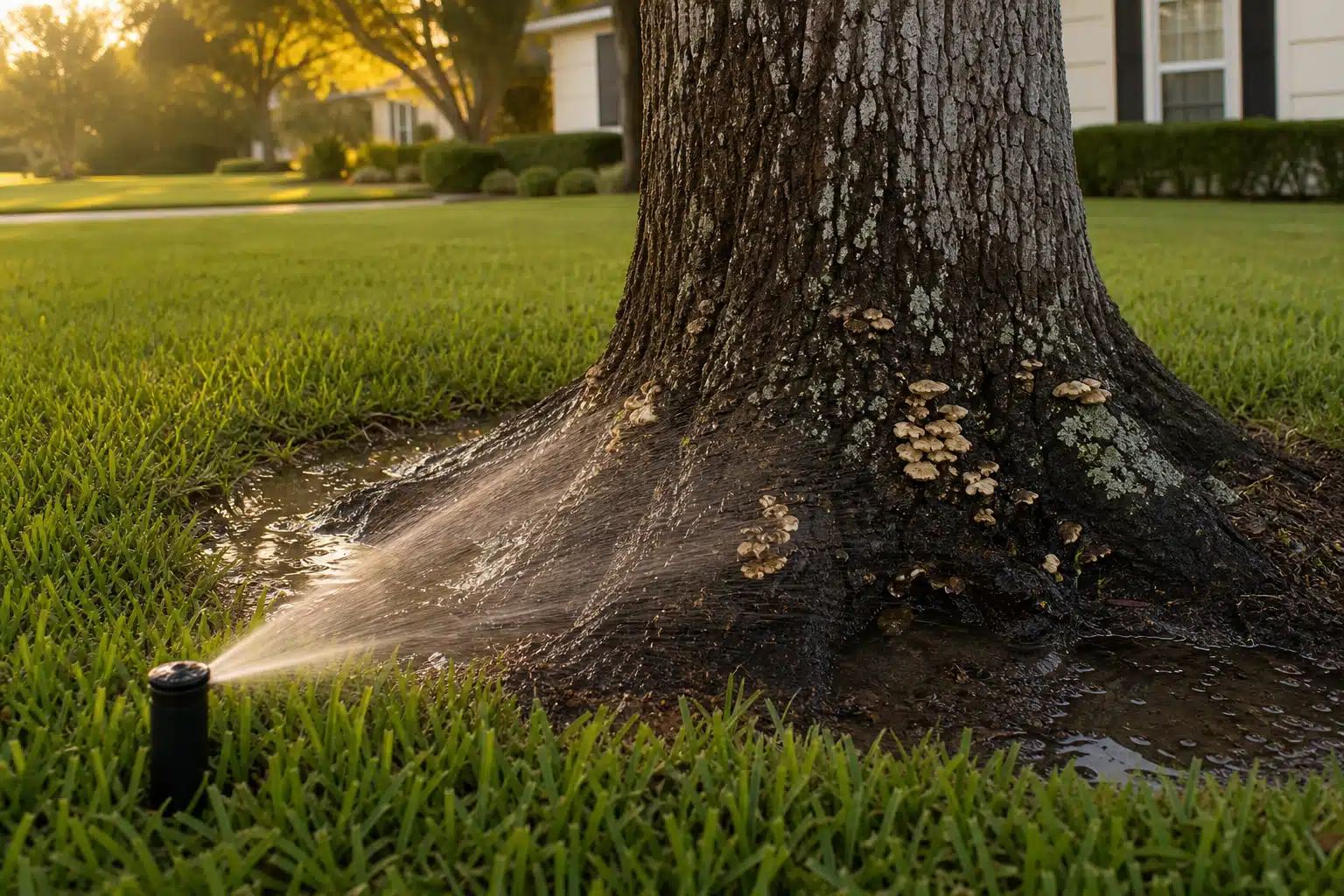
Beyond the moisture issues, the physical impact of irrigation spray on tree trunks is an underappreciated problem. Pop-up spray heads positioned too close to tree trunks bombard the bark with water two or three times a week, week after week, month after month.
This constant wetting of the bark creates conditions that favor bark-colonizing fungi and bacteria. The cambium layer beneath the bark is a living tissue, and sustained moisture on the trunk surface can lead to bark deterioration, particularly on thin-barked species like maples, pecans, and young oaks.
In addition, spray heads that strike the trunk directly can erode bark over time, especially on newly planted trees with thin, developing bark. The wounds may be small, but they accumulate and create entry points for opportunistic pathogens.
Irrigation Chemicals and Soil Chemistry
North Texas municipal water is treated with chlorine or chloramine, which at the concentrations used for drinking water are generally safe for plants. However, the cumulative effect of years of irrigation with treated water can affect the soil microbiome, particularly the beneficial mycorrhizal fungi and soil bacteria that trees depend on.
Additionally, many DFW irrigation systems draw from wells that tap into the region’s limestone aquifers, producing water with high calcium carbonate levels. Over years, this alkaline water can further raise an already alkaline soil pH (most DFW soils are 7.5 to 8.5), exacerbating iron chlorosis in species like red oaks and maples that are already struggling with iron availability in our soils.
What You Can Do: Practical Solutions
Ripping out your irrigation system is not the answer. Lawns need water, and in a DFW summer, there is no getting around that. The goal is to modify your system and your watering practices so that your trees and your lawn can both thrive.
Create Dedicated Tree Watering Zones
The single most impactful change you can make is to separate your tree watering from your lawn watering. A qualified irrigation technician can create independent zones around major trees that run on a different schedule: less frequent, longer duration, and ideally using drip emitters or bubblers rather than spray heads.
A tree zone might run once every 7 to 14 days during summer, but for 2 to 4 hours at low volume, allowing water to soak deeply into the root zone rather than wetting only the surface. This mimics the natural rainfall pattern that trees are adapted to.
Adjust Spray Head Placement
Ensure that no spray heads are positioned to strike the trunk directly. Heads within the drip line of a tree should be adjusted to spray away from the trunk, or converted to low-volume bubblers that deliver water to the soil surface without bombarding the bark.
Extend Your Mulch Rings
A mulch ring around each tree (3 to 4 inches deep, extending as far toward the drip line as practical, and kept 3 to 6 inches away from the trunk) provides multiple benefits: it reduces soil surface moisture fluctuation, suppresses turfgrass competition for water and nutrients, protects against mower damage, and moderates soil temperature.
Importantly, a mulch ring also creates a visual and physical boundary that encourages you to direct irrigation away from the trunk zone. It is the simplest, most cost-effective thing you can do for your trees.
Audit Your Run Times and Frequency
Most DFW irrigation systems are programmed based on what the lawn needs and then left unchanged for years. At minimum, review your schedule seasonally:
- Spring (March to May): Reduce frequency as natural rainfall supplements irrigation. Trees are breaking dormancy and do not need heavy watering yet.
- Summer (June to September): This is when the lawn demands the most water and the disconnect with tree needs is greatest. If you cannot create separate tree zones, at least deep-water your trees manually once or twice a month by setting a slow-running hose under the drip line for 2 to 3 hours.
- Fall (October to November): Gradually reduce irrigation as temperatures cool. A deep fall watering before the first freeze helps trees prepare for dormancy.
- Winter (December to February): Most trees are dormant and need little supplemental water unless conditions are dry and windy. A single deep watering during warm, dry winter spells is usually sufficient.
Monitor for Early Warning Signs
Walk your property regularly and look for the symptoms described above: crown thinning, undersized leaves, bark changes near the soil line, exposed surface roots, or mushrooms at the base of trees. Early detection gives you and your ISA Certified Arborist more options for intervention.
The Big Picture
Your irrigation system was designed to keep your lawn alive. Your trees, on the other hand, were designed to survive on the natural water cycle of North Texas, which includes long dry spells punctuated by heavy rain events. When we force trees into a lawn’s watering rhythm, we undermine the very adaptations that make them resilient.
The fix is not complicated. It is mostly about awareness, thoughtful irrigation design, and a willingness to treat your trees as the distinct organisms they are rather than just tall parts of your lawn.
TreeNewal’s ISA Certified Arborists work with homeowners across Dallas-Fort Worth, including Southlake, Argyle, Flower Mound, Denton, Fort Worth, and surrounding communities, to diagnose irrigation-related tree stress and develop practical solutions. To schedule a consultation, contact us here or call 469-754-9014.
You May Also Like