Date June 30, 2026
When homeowners in the Dallas-Fort Worth area think about threats to their trees, they usually think about drought, storms, disease, and pests. What rarely comes to mind is the infrastructure running above and below their property: power lines, gas pipes, water mains, sewer lines, and communication cables. Yet these utilities have a significant and often underestimated impact on tree health, tree longevity, and the decisions homeowners need to make about their landscapes.
Understanding how utility infrastructure interacts with your trees can help you avoid costly mistakes, protect your investment in your landscape, and make informed choices about planting, maintenance, and tree preservation.
The Problem Above: Power Lines and Tree Canopies
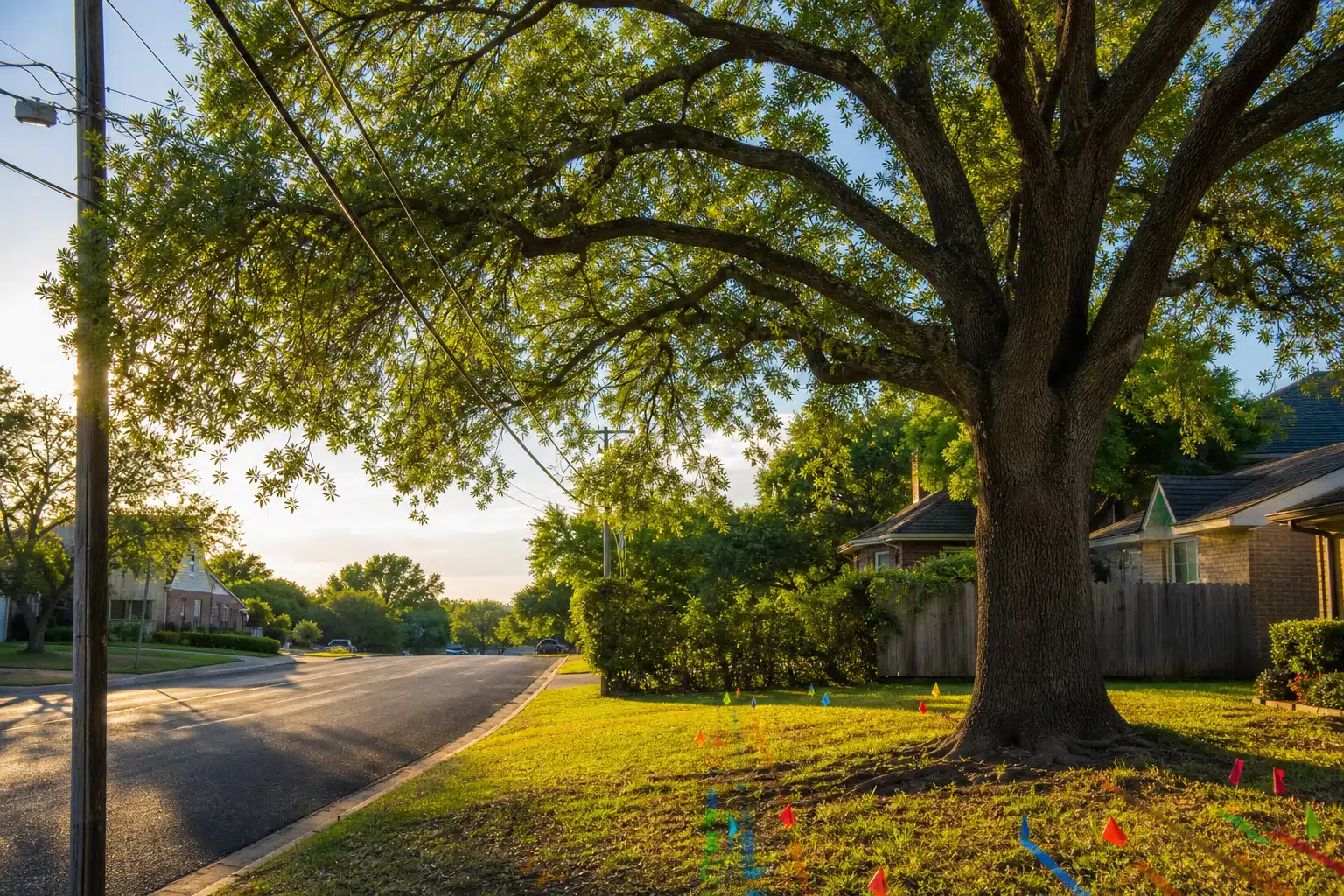
In most DFW neighborhoods, overhead power lines are a fact of life. Distribution lines typically run at 20 to 35 feet above ground, while service drops to individual homes may be lower. When trees grow into these clearance zones, utility companies have the right (and often the legal obligation) to prune them back.
The problem is that utility pruning and arboricultural pruning are not the same thing.
Utility Pruning Is Not Tree Care
Utility line clearance crews operate under a different set of priorities than ISA Certified Arborists. Their job is to maintain safe clearance from electrical conductors, period. They are not tasked with preserving the tree’s health, structure, or appearance.
This often results in directional pruning, where one entire side of the tree’s canopy is removed to create clearance from the lines. The result is a lopsided, unbalanced tree that looks like it was cut in half. Beyond aesthetics, this creates real structural and health problems:
- Directional pruning can produce an asymmetrical canopy that can alter load distribution and increase stress on remaining stems and branches. When combined with decay, defects, or severe weather, this may increase the likelihood of branch or tree failure.
- Large pruning wounds on one side create entry points for decay, particularly in North Texas species like red oaks that are susceptible to Hypoxylon canker when stressed.
- The tree may respond with a flush of rapid, weakly attached growth aimed back toward the lines, creating a cycle of aggressive regrowth and aggressive pruning that progressively weakens the tree.
What You Can Do
If you have trees growing near overhead utilities, you have several options:
Proactive crown management.
An ISA Certified Arborist can structurally and directionally prune trees that are safely outside utility clearance zones, encouraging healthy growth away from future conflicts with power lines. Once a tree grows too close to utility lines, required clearance pruning must be performed by the utility company.
Species selection for new plantings.
Oncor and other DFW utility providers publish guidelines for planting near power lines. In general, only small-maturing species (those reaching 25 feet or less at maturity) should be planted within 20 feet of overhead lines. Medium trees (25 to 40 feet) should be planted at least 25 feet away, and large trees (over 40 feet) should be at least 50 feet from lines.
Understanding your rights.
In Texas, utility easements typically give the utility company the right to prune or remove trees within the easement zone. However, for trees outside the easement but within reach of utility lines, the situation can be more nuanced. Understanding where your easement boundaries are (typically noted on your property survey) helps you plan plantings and advocate for your trees.
The Problem Below: Underground Utilities and Tree Roots
The interaction between tree roots and underground utilities is a slower, more insidious process than the overhead conflict, but it can be just as damaging to both the trees and the infrastructure.
How Deep Do DFW Tree Roots Actually Grow?
One of the most persistent myths in tree care is that roots mirror the canopy above, growing deep into the ground like an upside-down version of the branches. In reality, the vast majority of tree roots in North Texas grow in the top 12 to 24 inches of soil.
This is especially true in DFW’s heavy clay soils, which become compacted and oxygen-poor below the first couple of feet. Tree roots need oxygen, water, and nutrients, all of which are concentrated near the surface. The result is a root system that spreads horizontally, often extending two to three times the radius of the canopy.
This means that the roots of a mature live oak with a 40-foot canopy spread may extend 80 to 120 feet from the trunk, directly through the zones where utility lines, sewer pipes, water mains, and gas lines are buried.
Root Intrusion Into Sewer and Water Lines
Tree roots are drawn to moisture, and sewer and water lines are a constant source of it. Even small leaks or condensation on the outside of pipes can attract roots from surprising distances.
Once roots find a pipe, they exploit any vulnerability. Older clay or cast-iron sewer lines common in established DFW neighborhoods often have joints that separate slightly over time due to soil movement (a constant issue in North Texas expansive clay). Roots enter through these gaps and proliferate inside the pipe, fed by the water and nutrients they find there.
The result is progressive blockage. You may notice slow drains, gurgling sounds, or sewage backups. By the time the blockage is severe enough to require professional clearing, the roots may have completely filled sections of the pipe.
Species with particularly aggressive root systems include:
- Cottonwood: Extremely aggressive water-seeking roots
- Willow: Notorious for root intrusion into sewer lines
- American Elm and Cedar Elm: Common in DFW, known for expansive root networks
- Silver Maple: Shallow, aggressive root systems
- Live Oak: While not as aggressive as cottonwood, the sheer size and spread of live oak root systems means they frequently encounter underground utilities
Root Damage From Utility Repairs
The flip side of root intrusion is the damage that utility repair and installation can do to tree roots. When utility companies dig trenches for new lines, repair existing pipes, or install fiber optic cables, they often sever major roots in the process.
Because most DFW tree roots are concentrated in the top 24 inches, even a relatively shallow trench can cut through critical root zones. A trench cut within the drip line of a mature tree can sever 25 to 50 percent of the tree’s functional root system, depending on the proximity and the direction of the cut.
The effects may not be immediately visible. Trees that lose significant root mass often:
- Show stress symptoms 6 to 18 months after the damage, as stored energy reserves are depleted
- Develop crown dieback, starting with the branch tips farthest from the trunk
- Become more susceptible to secondary stressors like drought, heat, and opportunistic diseases
- Lean or fail during storms due to compromised anchorage
In North Texas, where trees are already dealing with extreme heat and clay soil challenges, the loss of even a portion of the root system can push a tree from stable to declining.
Gas Lines and Root Interaction
Natural gas leaks, even small ones, can kill tree roots and soil organisms in the immediate vicinity. Methane displaces oxygen in the soil, and the lack of oxygen (combined with the presence of ethane and other trace gases) kills roots and the beneficial mycorrhizal fungi that trees depend on for nutrient uptake.
If you notice a patch of dead grass or unexplained decline in a tree near a known gas line, it is worth contacting your gas utility to check for leaks. The symptoms mimic drought stress or soil issues, but the cause requires a very different response.
Planning Ahead: Smart Planting Near Utilities
The best way to prevent conflicts between trees and utilities is to plan for them before you plant. Here are practical guidelines for DFW homeowners:
Before You Dig, Call 811
Texas law requires that you call 811 (the national “Call Before You Dig” line) at least 48 hours before any digging project, including planting a tree. The service is free, and utility companies will mark the approximate location of underground lines on your property. This simple step prevents you from damaging a gas, water, or communication line during planting, and it shows you where future root conflicts are most likely.
Match Tree Size to Available Space
The most effective prevention is choosing a tree whose mature root spread will not reach underground utilities. This means:
- For areas within 10 feet of sewer or water lines, choose small trees with less aggressive root systems, such as Texas redbud, desert willow, or yaupon holly.
- For areas 10 to 25 feet from utility lines, medium trees like cedar elm or chinkapin oak are reasonable choices, with the understanding that root barriers may be needed.
- For areas more than 25 feet from underground utilities, larger species like live oak, pecan, or Shumard red oak can be planted with less concern about root conflicts.
Protect Trees During Construction
If utility work is planned near your trees, you can take proactive steps to minimize root damage:
- Request that the utility contractor use trenchless (directional boring) methods rather than open trenching whenever possible. This technology tunnels beneath root zones rather than cutting through them.
- If open trenching is unavoidable, request that roots be cleanly cut rather than torn or ripped. Clean cuts compartmentalize more effectively and reduce the risk of decay.
- After construction, apply supplemental watering and mulch to the affected root zone to support recovery.
- Have an ISA Certified Arborist assess the tree within 30 days of the work to identify any immediate concerns and establish a monitoring plan.
Protecting What Is Already There
For homeowners with established trees and existing utility infrastructure, the goal is ongoing awareness and proactive management. Schedule regular inspections with an ISA Certified Arborist who can evaluate root health, identify early signs of utility-related stress, and recommend interventions before problems become emergencies.
The trees in your DFW yard and the infrastructure beneath and above your property are going to coexist for decades. Managing that relationship thoughtfully is one of the smartest investments you can make in both your landscape and your home.
TreeNewal’s ISA Certified Arborists help homeowners across Dallas-Fort Worth, including Southlake, Argyle, Flower Mound, Denton, Fort Worth, and surrounding communities, navigate the complex relationship between trees and infrastructure. To schedule a consultation, visit us here or call 469-754-9014.
You May Also Like