Date July 10, 2026
Category
There is a quiet problem affecting trees across Dallas-Fort Worth neighborhoods, and it is happening right beneath your feet. Soil compaction, the gradual compression of soil particles that squeezes out the air spaces between them, is one of the most common yet least recognized causes of tree decline in North Texas.
You cannot see it happening. There are no dramatic symptoms like a sudden branch drop or a visible fungal infection. Instead, soil compaction works slowly, degrading your tree’s health over months and years until one day you notice that your once-thriving shade tree looks thin, stressed, and tired. By then, the problem has often been building for a long time.
Understanding how compaction happens, why it is so damaging, and what you can do about it puts you ahead of most homeowners when it comes to protecting your trees.
What Happens When Soil Gets Compacted
Healthy soil is not solid. It is a matrix of mineral particles, organic matter, water, and air. In a well-structured soil, roughly 50 percent of the volume is solid material and 50 percent is pore space, divided roughly equally between air and water.
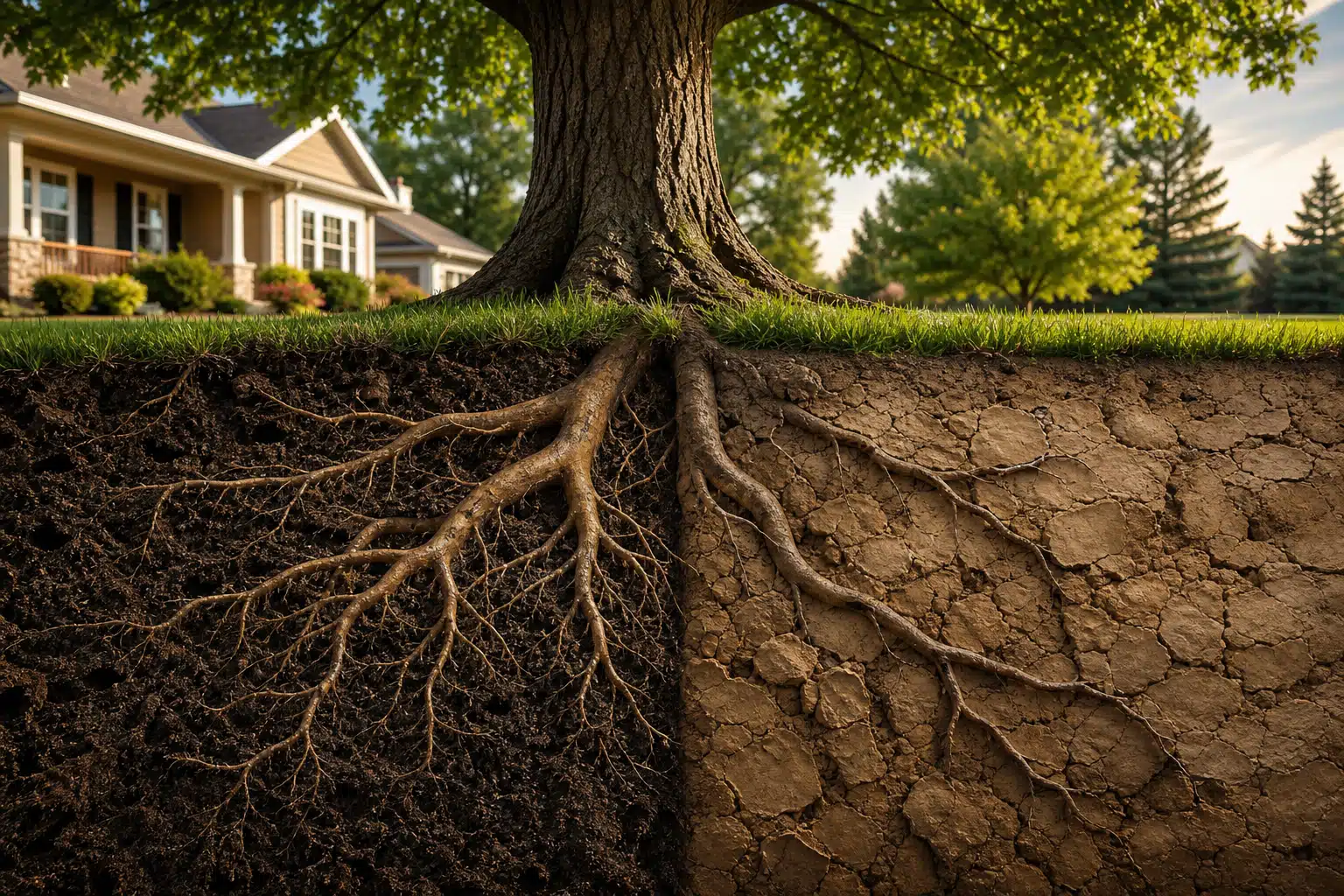
Tree roots need all three components: minerals for nutrients, water for hydration, and air (specifically oxygen) for cellular respiration. When soil becomes compacted, the pore spaces collapse. Water drains poorly, oxygen cannot penetrate, and roots literally suffocate.
In DFW’s heavy clay soils, the problem is amplified. Clay particles are tiny and plate-shaped, meaning they pack together more tightly than sand or loam when compressed. Once compacted, clay soil resists recovery far more stubbornly than lighter soil types. Without intervention, compacted clay can remain in its compressed state for decades.
Common Causes of Compaction in DFW Yards
Soil compaction is not caused by a single dramatic event. It accumulates over time through routine activities that most homeowners never think twice about.
Foot Traffic
The most universal cause is simply walking on the soil. A well-worn path across your lawn, a spot where kids play, or the route you take to your mailbox every day gradually compresses the soil surface. Over years, this casual foot traffic can compact the top 6 to 12 inches of soil, which is precisely the zone where the majority of feeder roots grow.
Vehicle and Equipment Traffic
Driving vehicles, riding mowers, or heavy equipment across the root zone of a tree creates severe compaction. Construction projects are the worst offenders. When a new home is built in a DFW subdivision, heavy equipment (dump trucks, backhoes, concrete trucks) routinely drives over the areas that will eventually become the yard. The compaction created during construction can persist for the lifetime of the home if not addressed.
Even after construction, parking cars on unpaved areas, driving lawn tractors repeatedly over the same paths, or staging heavy materials (pallets of pavers, soil deliveries) on the root zone all contribute to ongoing compaction.
Rain Impact on Bare Soil
In areas where the ground is bare (no grass, mulch, or groundcover), rain strikes the soil surface directly. Each raindrop acts like a tiny hammer, breaking apart surface structure and washing fine particles into the pore spaces below. Over time, this creates a dense, crusty surface layer that sheds water rather than absorbing it.
This is common around the base of trees where grass struggles to grow in deep shade, creating a negative feedback loop: bare soil leads to compaction, which leads to poor root health, which leads to more bare soil.
Overwatering and Poor Drainage
Paradoxically, too much water also contributes to compaction. Saturated clay soil is soft and easily compressed by even light pressure. Homeowners who overwater their lawns, or whose properties have poor drainage, may be creating conditions where every footstep or mower pass causes more compaction than it would on properly drained soil.
How Compaction Damages Trees
The effects of soil compaction on trees are systemic. It does not just affect one part of the tree; it undermines the entire organism from the roots up.
Oxygen Starvation
Tree roots need oxygen to function. In compacted soil, oxygen levels drop dramatically because air cannot penetrate the compressed pore spaces. Without adequate oxygen, roots cannot perform cellular respiration, which is how they generate the energy needed to absorb water and nutrients.
The fine feeder roots, the ones responsible for the vast majority of water and nutrient uptake, are the first to die in low-oxygen conditions. As these roots die off, the tree’s ability to feed itself diminishes.
Poor Water Infiltration
Compacted soil repels water rather than absorbing it. When you water your lawn or when it rains, water pools on the surface or runs off rather than soaking into the root zone. The tree may be surrounded by water on the surface but completely dry where its roots actually are.
This is a common reason homeowners say, “I water my tree all the time, but it still looks stressed.” The water is there, but the compacted soil is keeping it from reaching the roots.
Restricted Root Growth
Tree roots follow the path of least resistance. In healthy soil, they spread freely through the pore spaces, exploring for water and nutrients. In compacted soil, they hit a physical barrier. Roots may grow along the surface rather than spreading outward, creating a shallow, unstable root system. In extreme cases, roots circle near the surface, becoming girdling roots that can eventually strangle the tree’s own trunk.
Reduced Microbial Activity
Healthy soil is teeming with life. Bacteria, fungi (including beneficial mycorrhizal fungi), protozoa, nematodes, and earthworms all play critical roles in breaking down organic matter, cycling nutrients, and maintaining soil structure. Compaction suppresses this biological activity by reducing oxygen and moisture availability.
The loss of mycorrhizal fungi is particularly damaging. These fungi form symbiotic relationships with tree roots, dramatically expanding the root system’s effective reach. A tree with healthy mycorrhizal associations can access water and nutrients from a much larger volume of soil than one relying on its roots alone. When compaction kills off these fungi, the tree loses a critical support system.
Signs Your Tree Is Suffering from Compacted Soil
Because compaction works slowly, its symptoms often look like other problems. Here is what to watch for:
Sparse or small leaves. A tree that is not getting enough water and nutrients produces fewer, smaller leaves than it should.
Early fall color or premature leaf drop. Trees under root stress often shut down earlier in the season than healthy specimens of the same species.
Dieback starting at branch tips. The outermost parts of the canopy are the last to receive water and nutrients, so they decline first when the root system is compromised.
Mushroom or fungal growth at the base. Stressed trees with compromised roots are more susceptible to root-rotting fungi. Mushrooms appearing at the base of the tree or on surface roots may indicate decay in progress.
Standing water or runoff. If water pools around your tree after watering or rain rather than soaking in, the soil is likely compacted.
Hard, cracked soil surface. During dry periods, compacted clay soil cracks and becomes rock-hard. If you cannot push a screwdriver into the soil around your tree without significant effort, compaction is likely a factor.
Solutions That Work
The good news is that soil compaction is treatable. It takes time and the right approach, but trees can recover when the root zone environment is improved.
Air Spading (Radial Trenching)
The most effective professional treatment for compacted soil is air spading, a process in which compressed air is used to break up the soil around a tree’s root zone without damaging the roots. Unlike digging with a shovel or tilling with mechanical equipment (both of which would sever roots), the air tool loosens soil while leaving roots intact.
After the soil is loosened, organic matter and compost or expanded shale can be mixed in to improve long-term structure. The result is a root zone that holds air, absorbs water, and supports the biological communities that trees depend on.
Vertical Mulching
For less severe compaction, vertical mulching involves drilling holes (typically 2 to 4 inches in diameter) throughout the root zone and filling them with a mix of compost and porous material. This creates channels for air and water to penetrate the compacted layer, jumpstarting the recovery process.
Deep Mulch Application
Applying a 3 to 4-inch layer of organic mulch (shredded hardwood or composted wood chips) over the root zone does multiple things: it protects the soil surface from further compaction caused by rain impact, retains moisture, moderates soil temperature, and provides a slow feed of organic matter as it breaks down. Over time, mulch-fed biological activity (earthworms, fungi, bacteria) naturally works to decompact the upper soil layers.
The key with mulch is proper application. Keep it 3 to 6 inches away from the trunk (no mulch volcanoes) and extend it as far toward the drip line as practical.
Reducing Traffic
No amount of soil restoration will last if the causes of compaction continue. Identify high-traffic paths through your yard and reroute them away from tree root zones if possible. Use stepping stones or designated pathways to concentrate foot traffic into narrow corridors rather than spreading it across the root zone.
For construction projects, establish and enforce tree protection zones (typically at a radius of at least 1 foot per inch of trunk diameter) to keep equipment and material storage away from root systems.
Prevention Is Easier Than Repair
If you are building a new home, renovating your landscape, or planting new trees, consider soil compaction from the start:
- Specify tree protection zones in your construction contracts
- Amend compacted builder soil before planting new trees
- Choose planting locations away from high-traffic areas
- Install mulch beds around trees from day one
- Avoid planting in areas that will become vehicle parking zones
The Long View
Your trees are long-term investments. A mature live oak or pecan in a DFW yard can be worth tens of thousands of dollars in property value and provides shade, beauty, and environmental benefits that no man-made structure can replicate. Protecting the soil environment around those trees is one of the most impactful things you can do to ensure they thrive for decades.
TreeNewal’s ISA Certified Arborists offer soil assessment, air spading, vertical mulching, and comprehensive root zone restoration for homeowners across Dallas-Fort Worth, including Southlake, Argyle, Flower Mound, Denton, Fort Worth, and surrounding communities. To learn more about protecting your trees from the ground up, contact us here or call 469-754-9014.
You May Also Like