Date May 27, 2026
Category
Your tree looks perfectly healthy from above. The canopy is full, the leaves are green, and nothing seems out of place. But beneath the surface, something could be slowly strangling it from the inside out. Girdling roots are one of the most overlooked tree health problems we encounter as ISA Certified Arborists serving the Dallas-Fort Worth area. These rogue roots wrap around the base of a tree’s trunk, quietly choking off water and nutrient flow. In the rapidly developing neighborhoods across DFW, where compacted clay soils and container-grown nursery stock are the norm, girdling roots have become increasingly common. The worst part? By the time most homeowners notice the symptoms, years of damage have already been done.
What Are Girdling Roots?
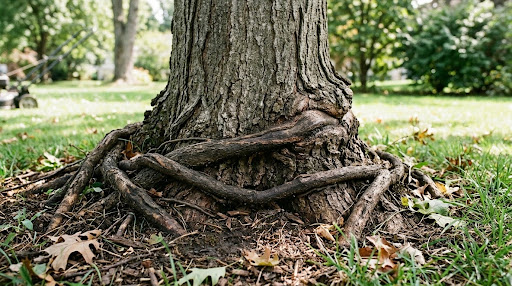
In a healthy tree, roots grow outward from the trunk in a radial pattern, anchoring the tree and absorbing water and nutrients from the surrounding soil. Girdling roots grow in a different direction entirely. Instead of spreading outward, these roots grow laterally or in a circular pattern around the base of the trunk. Over time, they wrap tightly around the trunk or over other major roots, creating a constriction that acts much like a tourniquet on a limb.
As the tree and the girdling root both continue to grow in diameter, the pressure intensifies. The root compresses the trunk’s vascular tissue, which is responsible for transporting water up to the canopy and sugars back down to the roots. Sometimes called circling roots, these problematic roots can affect trees of any species, though maples, Chinese pistaches, and oaks are particularly susceptible. The process can take years or even decades, which is precisely what makes girdling roots so dangerous.
What Causes Girdling Roots?
Girdling roots rarely develop by accident. They are almost always the result of specific conditions during or after planting. Understanding the root causes helps you prevent tree root problems before they start.
Container-grown nursery stock is one of the most common culprits. When a tree grows in a pot for too long, its roots hit the container walls and begin circling. If those circling roots are not corrected at planting time, they continue their circular growth pattern in the ground, eventually girdling the trunk as the tree matures.
Improper planting depth is another frequent cause. Trees planted too deeply develop roots that grow upward toward the surface rather than outward, and these misdirected roots often cross over the trunk base. Compacted soils compound the problem, especially in DFW where heavy clay is the dominant soil type. Roots struggle to penetrate dense soil and instead deflect and circle within the looser backfill of the planting hole.
Urban development creates additional challenges. Root deflection from sidewalks, foundations, and retaining walls forces roots to change direction and grow back toward the trunk. Restricted root space in parking lot islands and narrow planting strips gives roots nowhere to go but in circles. In many newer communities across Southlake, Flower Mound, and North Richland Hills, these conditions are the rule rather than the exception.
How to Identify Girdling Roots
One of the best ways to check for girdling roots is what arborists call “the flare test.” A healthy tree should display a visible root flare at the soil line, where the trunk widens and transitions into the root system. It should look like the base of a wine glass, gradually expanding outward. If your tree’s trunk goes straight into the ground like a telephone pole with no visible flare, that is a strong indication that the root flare is buried and girdling roots may be present.
Several other visual signs can help you spot this problem. Look for one-sided canopy thinning, where leaves on one side of the tree are smaller or fewer while the rest of the canopy looks normal. This asymmetric decline often corresponds to the side where a girdling root is restricting flow. Check the base of the trunk for bark that appears compressed, flattened, or creased. You may also see visible roots crossing over the trunk at the soil surface.
Other symptoms include early leaf drop, reduced annual growth, and dieback in the upper canopy. Because many of these symptoms overlap with other tree health issues, accurate diagnosis often requires a professional root crown inspection by an ISA Certified Arborist who can excavate the soil around the base and assess the root architecture directly.
The Damage Girdling Roots Cause
The consequences of untreated girdling roots extend far beyond cosmetic decline. As the constriction tightens over the years, water and nutrient uptake becomes increasingly restricted. The canopy gradually thins, branches begin to die back, and overall vigor declines. A girdling root can take 10, 20, or even 30 years to kill a tree, meaning the problem often originated at planting and went unnoticed for decades.
Beyond the slow decline in health, girdling roots create serious structural instability. A tree with a compromised root system is far more vulnerable to windthrow during the severe storms that regularly sweep through the DFW metroplex. The trunk may also weaken at the point of constriction, creating a failure point that could cause the tree to snap or topple. A mature shade tree adds significant value to your property, and losing one means losing decades of growth along with the energy savings, privacy, and curb appeal it provided.
Treatment Options for Girdling Roots
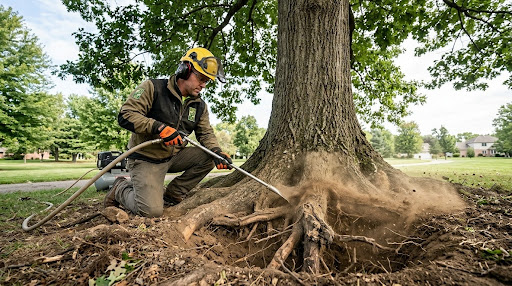
Girdling root treatment begins with a thorough diagnosis. At TreeNewal, our ISA Certified Arborists use a technique called root crown excavation, which employs a specialized tool known as an air spade. The air spade uses compressed air to gently remove soil from around the root zone without damaging the roots, a critical advantage over digging with shovels or other mechanical tools.
Once the root crown is exposed, the arborist can assess the full extent of the problem and determine which roots need to be addressed. Selective root pruning involves carefully cutting and removing the girdling roots while preserving the healthy structural and feeder roots the tree depends on. This is where professional expertise is essential. Removing the wrong root can destabilize the tree or cause more harm than the girdling root itself.
Timing matters as well. Root pruning is generally best performed during the dormant season or early spring, when the tree has the greatest energy reserves to recover. After treatment, proper mulching, watering, and ongoing monitoring help the tree heal and re-establish a healthy root architecture.
Preventing Girdling Roots
Prevention starts long before a tree goes into the ground. When purchasing a new tree, inspect the root ball carefully. If you see roots circling tightly around the inside of the container, either correct them at planting by cutting or spreading them outward, or choose a different specimen.
Planting depth is critical. The root flare should sit at or just above the soil line, never buried beneath mulch or fill dirt. In DFW’s heavy clay soils, amending the planting area and ensuring proper drainage helps roots grow outward rather than circling within the backfill. Avoid volcano mulching (piling mulch against the trunk), which encourages roots to grow upward into the mulch layer and cross over the trunk. Schedule regular root crown inspections with an ISA Certified Arborist, especially for trees that are five to ten years old, to catch circling roots before they become a serious problem.
Protect Your Trees Before It’s Too Late
Girdling roots are a hidden threat, but they do not have to be a death sentence for your trees. Early detection and professional treatment can save trees that might otherwise be lost. At TreeNewal, our ISA Certified Arborists use advanced techniques like air spade root crown excavations to diagnose and treat girdling root problems across the Dallas-Fort Worth area, including Southlake, Keller, Colleyville, Grapevine, Argyle, Denton, and surrounding communities. If you have noticed any of the warning signs described above, or if you want peace of mind about the health of your trees, call us at 469-754-9014 or visit treenewal.com to schedule a consultation.
Frequently Asked Questions
Can girdling roots kill a tree?
Yes. Girdling roots can kill a tree, though the process is usually slow. As the root tightens around the trunk, it progressively cuts off the flow of water and nutrients. Depending on the severity and the species, this can take 10 to 30 years. Early intervention through professional root crown excavation and selective pruning can often save the tree.
How much does girdling root treatment cost?
The cost varies depending on the size of the tree, the severity of the problem, and the complexity of the root crown excavation required. An air spade root crown excavation with selective root pruning typically ranges from a few hundred to over a thousand dollars. Contact TreeNewal at 469-754-9014 for a personalized estimate.
What trees are most susceptible to girdling roots?
Maples, Chinese pistaches, oaks, and elms are among the species most commonly affected. However, any tree can develop this condition, particularly if it was container-grown, planted too deeply, or growing in compacted soil. In DFW, live oaks and red oaks are frequently affected due to clay soils and urban planting conditions.
Can I fix girdling roots myself?
While you can identify potential girdling roots by performing the flare test, treatment should be left to an ISA Certified Arborist. Removing the wrong root can destabilize the tree or cause further decline. Professional root crown excavation with an air spade is the safest method for exposing and addressing girdling roots without damaging the tree’s healthy root system.
You May Also Like