Date July 16, 2026
Category
Every tree in your Dallas-Fort Worth yard carries scars. Pruning cuts, storm damage, insect bore holes, bark scrapes from lawn equipment, old branch stubs from decades past. Unlike animals, trees cannot regenerate damaged tissue. They cannot grow new cells to replace the ones that were destroyed. Yet mature trees routinely survive with wounds that would be fatal to most living organisms.
The secret to their survival is a process called compartmentalization, one of the most elegant defense systems in the natural world. Understanding how compartmentalization works changes the way you think about tree care, pruning, wound treatment, and what it really means when someone says a tree is “healing.”
Trees Do Not Heal. They Seal.
This is the fundamental distinction that separates tree biology from animal biology, and it is the concept most homeowners (and unfortunately, some tree service providers) get wrong.
When you cut your finger, your body produces new cells that replace the damaged tissue. The wound actually heals: new skin forms, and eventually the area returns to something close to its original state.
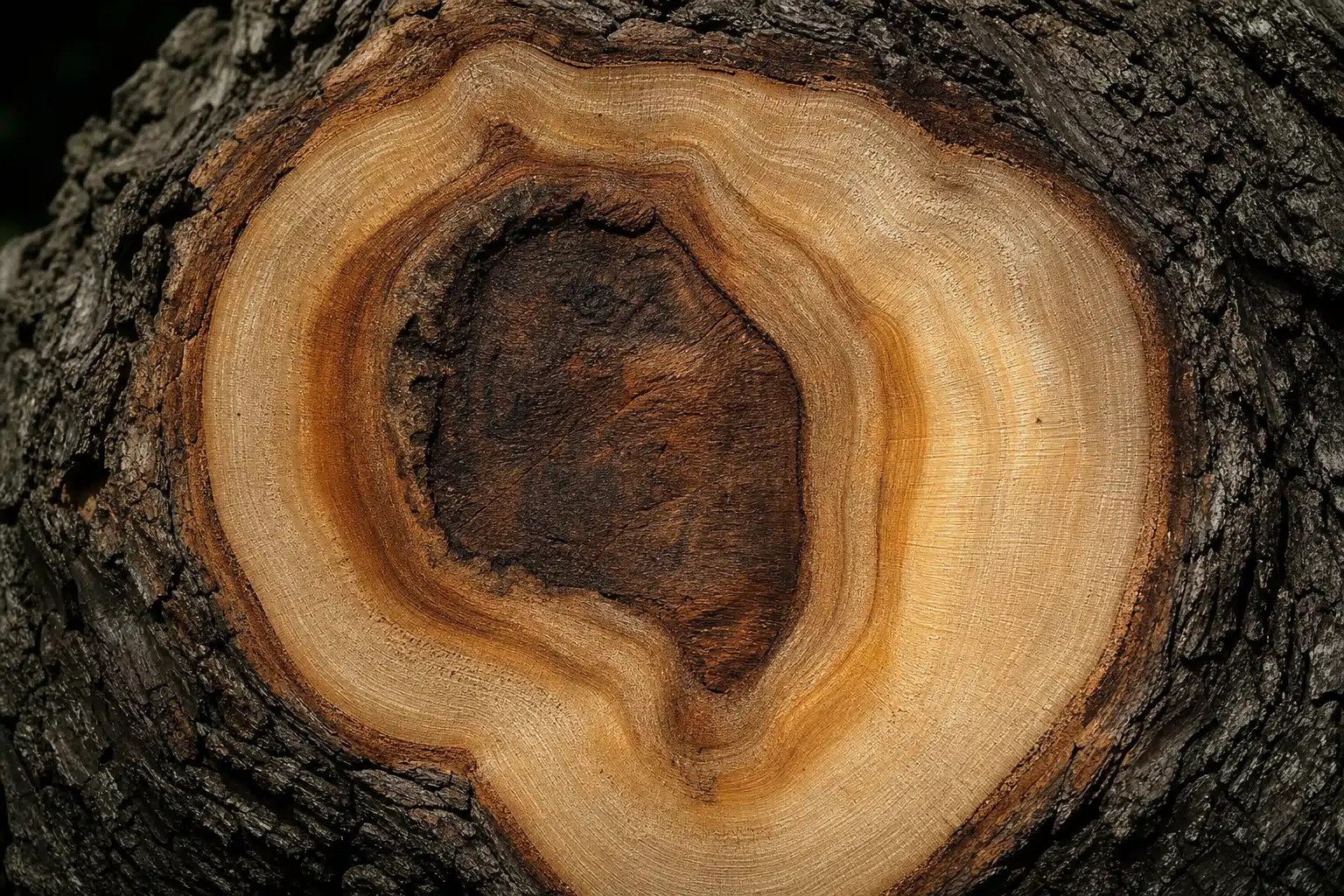
Trees cannot do this. When wood is damaged, whether by a saw, a storm, or a boring insect, the damaged wood stays damaged forever. It does not regenerate. Instead, the tree builds new wood around and over the wound, sealing it off from the rest of the tree like a building being walled off one room at a time.
The scientific framework for this process is called CODIT: Compartmentalization of Decay in Trees. It was developed by Dr. Alex Shigo, a plant pathologist with the U.S. Forest Service, whose decades of research fundamentally changed how arborists understand tree biology.
The Four Walls of CODIT
When a tree is wounded, decay organisms (fungi and bacteria) immediately begin colonizing the exposed wood. The tree cannot kill these organisms or remove the infected tissue. Instead, it creates chemical and physical barriers to contain the decay and prevent it from spreading into healthy wood.
Dr. Shigo described these barriers as four “walls,” each operating in a different direction:
Wall 1: Above and Below
The first wall restricts decay from spreading vertically, up and down through the wood above and below the wound. The tree creates chemical changes in the cells of the water-conducting vessels (xylem), plugging them with compounds called tyloses and other substances that block the movement of fungi and bacteria along the grain of the wood.
Wall 1 is the weakest of the four barriers. Decay tends to spread more easily along the grain (vertically) than across it, which is why you often see vertical columns of decay inside trunks and branches rather than wide, spreading patches.
Wall 2: Inward
The second wall prevents decay from spreading inward toward the center of the tree (the heartwood). This wall is formed by the cells of the annual growth rings. Each ring represents a boundary between one year’s growth and the next, and the tree uses these natural boundaries as chemical defense lines.
Wall 2 is relatively effective, particularly in species with distinct annual rings. The dense latewood (the darker portion of each ring) provides a stronger physical barrier than the lighter earlywood.
Wall 3: Lateral
The third wall prevents decay from spreading sideways, around the circumference of the trunk or branch. This wall is formed by the ray cells, which are specialized cells that run radially from the center of the tree outward, like spokes on a wheel.
Ray cells can produce antimicrobial compounds and physically block the lateral spread of decay organisms. Wall 3 is generally stronger than Walls 1 and 2, which is why decay columns inside trees tend to be narrow and elongated rather than wide and circular.
Wall 4: Outward (The Barrier Zone)
The fourth wall is the strongest and most important. It is fundamentally different from the other three because it is not formed from existing wood. Instead, Wall 4 is created by the tree’s cambium (the thin layer of actively growing cells between the bark and the wood) after the wound occurs.
The cambium produces a special layer of cells called the barrier zone, which contains high concentrations of antimicrobial compounds. This barrier zone becomes part of the new wood that the tree grows after the wounding event. It separates the old wood (which may contain decay) from the new wood (which is protected).
Wall 4 is remarkably effective. In many cases, a tree can have extensive internal decay in the wood that existed before the wound while the wood grown after the wound remains perfectly healthy, all separated by this thin but powerful barrier zone.
Why This Matters for Tree Care
Understanding compartmentalization has practical implications for every aspect of how you care for your trees.
Pruning Cuts Matter Enormously
When an ISA Certified Arborist makes a pruning cut, they cut just outside the branch collar, the slightly swollen area where a branch connects to the trunk or parent branch. The branch collar contains the tree’s defense chemistry, and cutting outside it allows the tree to rapidly form Wall 4 and begin sealing the wound.
Flush cuts (cutting a branch flat against the trunk, removing the collar) destroy the tree’s primary defense zone. The wound is larger, the compartmentalization response is weaker, and decay is far more likely to penetrate into the trunk. This is one of the key reasons ISA Certified Arborists are trained to never make flush cuts.
Conversely, leaving a long stub when removing a branch also compromises compartmentalization. The stub dies back to the collar anyway, but the dead stub becomes a column of decaying wood that the tree must work to contain. Proper cuts eliminate dead stubs and preserve the collar.
Wound Dressings Do Not Help (and May Hurt)
For decades, it was standard practice to apply wound dressings, tar, paint, or sealant to pruning cuts and wounds. The theory was that sealing the wound from the outside would prevent decay from entering.
Research has conclusively shown that wound dressings do not improve compartmentalization and can actually make things worse. Many dressings trap moisture against the wound surface, creating a dark, humid environment that favors the very fungi and bacteria you are trying to keep out. Some dressings also crack as they dry, allowing moisture to enter but not escape.
The tree’s own compartmentalization process is more effective than any external product. After a proper pruning cut, the best thing you can do is leave the wound alone and let the tree do what millions of years of evolution have equipped it to do.
Tree Species Vary in Compartmentalization Ability
Not all trees compartmentalize equally well. Some species are strong compartmentalizers, forming robust chemical barriers quickly and effectively. Others are weak compartmentalizers, meaning wounds of the same size cause proportionally more damage.
Among common North Texas species:
Strong compartmentalizers:
- Live oak
- Bur oak
- Cedar elm
- Bald cypress
Moderate compartmentalizers:
- Shumard red oak
- Chinkapin oak
- Pecan
- American elm
Weaker compartmentalizers:
- Red maple
- Silver maple
- Cottonwood
- Willow
This does not mean you should avoid weak compartmentalizers. It means that pruning and wound management on these species requires extra care. Smaller cuts, proper timing, and attention to overall tree health all help a weak compartmentalizer succeed.
Tree Health Affects Compartmentalization Strength
A healthy, vigorous tree compartmentalizes far more effectively than a stressed one. The energy required to produce antimicrobial compounds, form tyloses, and build new growth over wounds comes from the tree’s energy reserves, which are replenished through photosynthesis.
A tree that is stressed by drought, nutrient deficiency, compacted soil, pest damage, or previous over-pruning has fewer energy reserves to devote to compartmentalization. This is one of the many reasons that maintaining overall tree health through proper watering, soil management, and proactive care is so important. It is not just about the canopy you can see; it is about the defense systems you cannot.
In North Texas, where trees routinely face the compounding stresses of extreme summer heat, expansive clay soils, and periodic drought, maintaining tree vigor is critical to supporting effective compartmentalization.
Old Wounds Tell a Story
If you look at the base of a mature tree, you may see old wound areas where the bark has rolled inward, partially or fully closing over old pruning cuts or damage scars. This visible wound closure is the external evidence of compartmentalization at work.
It is tempting to think that once a wound has “closed over,” the problem is solved. But remember: the damaged wood inside has not been replaced. It has been walled off. In some cases, the decay column inside can be extensive even though the exterior looks fully closed.
This is why ISA Certified Arborists may use tools like resistograph drills or sonic tomography to assess internal wood integrity on mature trees, particularly those with a history of large wounds or visible decay indicators. What you see on the outside is not always a reliable indicator of what is happening inside.
Compartmentalization and Tree Longevity
The ability to compartmentalize is one of the primary reasons trees can live for centuries. A 200-year-old live oak has survived hundreds of wounds, storms, insect attacks, and disease challenges over its lifetime. Each one was compartmentalized, walled off, and left behind as the tree grew new wood over and around the damage.
This built-in resilience is remarkable, but it is not unlimited. Every compartmentalization event uses energy. Every wound, even a well-made pruning cut, triggers a defense response that costs the tree something. Cumulative damage from repeated wounding, poor pruning practices, construction damage, or chronic stress can eventually overwhelm even a strong compartmentalizer.
This is why thoughtful tree management matters. Every cut should have a purpose. Every intervention should be weighed against its cost to the tree. The best arborists are not the ones who prune the most; they are the ones who prune thoughtfully, balancing the homeowner’s goals with the tree’s capacity to respond.
Working With Your Tree’s Biology
The next time you look at a tree on your property, remember that beneath the bark, a sophisticated defense system is constantly at work, walling off damage, containing decay, and building new wood over old wounds. Your job as a homeowner is to support that system by keeping your trees healthy, hiring qualified professionals for pruning, and avoiding unnecessary damage.
TreeNewal’s ISA Certified Arborists understand the biology behind every cut and every recommendation they make. Serving homeowners across Dallas-Fort Worth, including Southlake, Argyle, Flower Mound, Denton, Fort Worth, and surrounding communities, they bring science-based tree care to every consultation. To learn more, contact us here or call 469-754-9014.
You May Also Like