Date June 20, 2026
Category
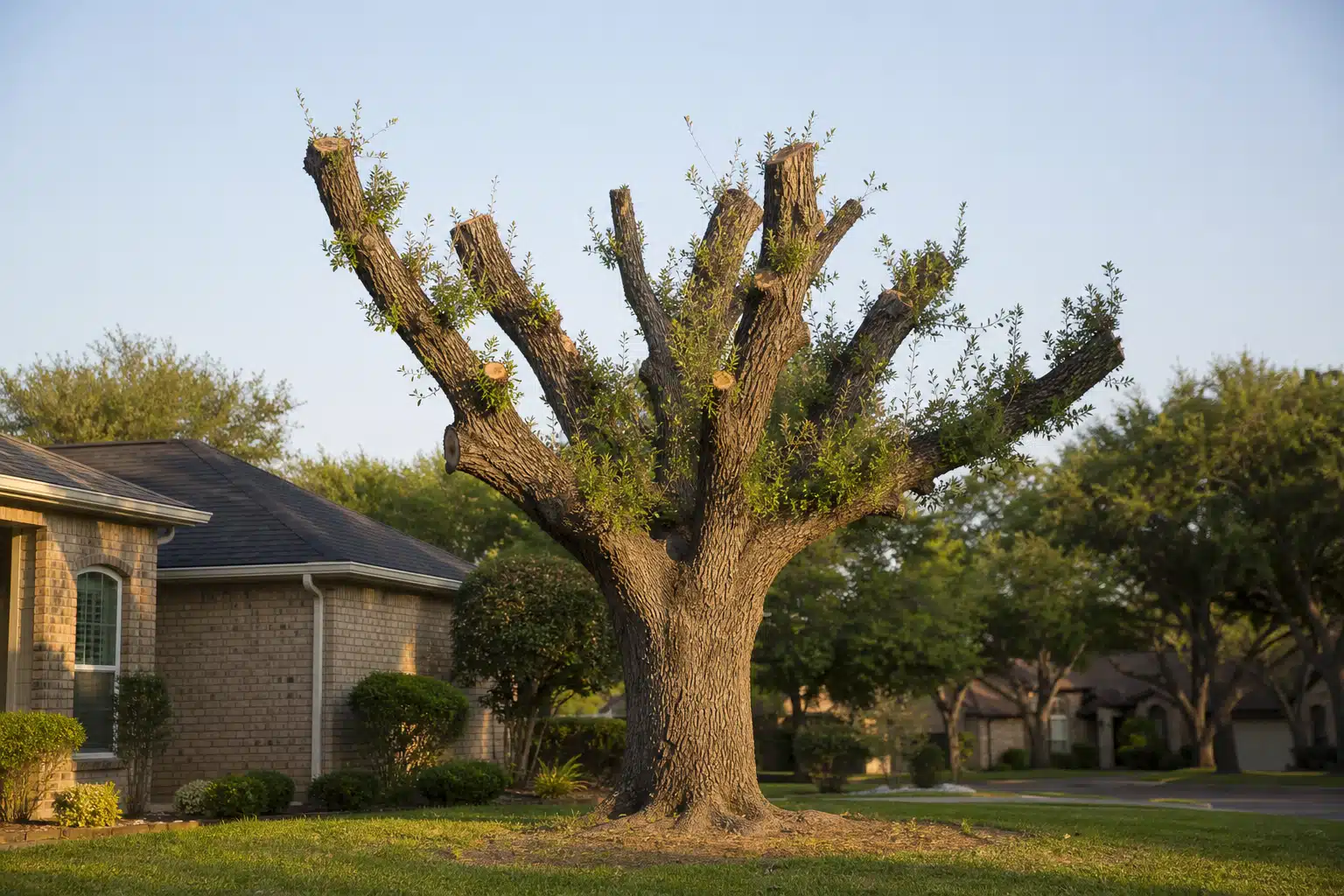
If you have driven through any neighborhood in the Dallas-Fort Worth area after storm season, you have likely seen it: trees with their tops lopped off, leaving behind thick, flat-cut stumps where branches used to be. The practice is called tree topping, and despite being one of the most common tree care requests in North Texas, it is also one of the most damaging things you can do to a tree.
Many homeowners top their trees with good intentions. They want to reduce the risk of storm damage, keep branches away from power lines, or simply control a tree that has grown larger than expected. On the surface, it seems logical: cut the top off, and the tree gets smaller. Problem solved.
Unfortunately, the reality is far more complicated. ISA Certified Arborists consider topping one of the most harmful tree care practices still in use today, and for good reason. Understanding why topping fails, and what to do instead, can save your trees, your property, and your wallet.
What Is Tree Topping?
Tree topping goes by several names. You may hear it called heading, hat-racking, rounding over, or tipping. Regardless of the term, the practice involves cutting large branches back to stubs or lateral branches that are too small to assume the role of a terminal leader. In most cases, topping removes 50 to 100 percent of the tree’s leaf-bearing crown in a single session.
The result is a tree that looks like it has received a flat-top haircut. Some homeowners prefer this look, assuming the tree will simply regrow into a more manageable shape. What actually happens is something far less predictable and far more dangerous.
The Starvation Response
Trees rely on their leaves to produce food through photosynthesis. When you remove the majority of a tree’s canopy in one cut, you are essentially removing its ability to feed itself. The tree enters a survival mode, triggered by starvation.
In response, the tree activates dormant buds along the remaining branch stubs, producing a flush of rapid new growth called epicormic shoots (sometimes called water sprouts). These shoots grow quickly, sometimes producing several feet of new growth in a single season. To the untrained eye, this rapid regrowth might look like a sign of health. In reality, it is a sign of desperation.
The tree is burning through its stored energy reserves to replace its lost canopy as fast as possible. If the tree does not have enough reserves, or if it is already stressed by drought, disease, or poor soil conditions common in North Texas clay soils, it may not survive the process at all.
Weak Attachment Points Create Greater Storm Risk
Here is the irony that makes topping so counterproductive: the very thing homeowners hope to prevent (storm damage) becomes more likely after topping.
Epicormic shoots that sprout from topped stubs are attached only to the outer layers of the parent branch. Unlike natural branches that develop over years with strong, integrated wood connections, these regrowth shoots have a shallow attachment. They are structurally weak.
As these shoots grow rapidly (some reaching the tree’s original height within just a few years) they become heavy, dense clusters of foliage. Because they are poorly attached, they are far more likely to break off during the strong summer thunderstorms and straight-line wind events that are common across the DFW metroplex from June through September.
In other words, a topped tree often becomes more dangerous than the tree you started with.
Decay and Disease Entry Points
Every topping cut creates an open wound, and large topping cuts create large open wounds. Unlike proper pruning cuts that are made just outside a branch collar (where the tree’s natural defense zone can seal the wound), topping cuts are made arbitrarily, often in the middle of a branch.
Trees cannot heal wounds the way humans do. Instead, they compartmentalize them, growing new wood over and around the damaged area to seal it off. But when cuts are large and improperly placed, the exposed wood becomes an entry point for decay fungi, bacteria, and wood-boring insects before the tree can respond.
In North Texas, topped trees are particularly vulnerable to Hypoxylon canker, which thrives on stressed, weakened wood. Once decay begins inside a topped branch, it can spread into the trunk, creating structural weaknesses that are invisible from the outside but catastrophic during high winds.
Sunscald and Bark Damage
The sudden removal of the upper canopy exposes interior branches and the trunk to direct Texas sun. Bark that was previously shaded can develop sunscald, a condition where intense sunlight damages or kills the living tissue beneath the bark.
Sunscald creates cankers, cracked bark, and additional entry points for disease. For species that are already dealing with the stresses of North Texas heat, such as red oaks, post oaks, and maples, this additional damage can tip the balance from stressed to declining.
The Financial Trap
Topping is often marketed as a budget-friendly alternative to proper pruning. And in the short term, it can be cheaper. But the long-term costs tell a different story.
Topped trees require more frequent maintenance. The rapid epicormic growth must be cut back repeatedly, often every one to two years, creating an ongoing expense. Each round of topping further weakens the tree, increases disease risk, and makes the next round of growth even more problematic.
If the tree eventually dies (a common outcome for repeatedly topped trees), you face the cost of removal and replacement. Mature tree removal in the DFW area can cost thousands of dollars, and replacing a mature tree’s shade, property value contribution, and aesthetic presence takes decades.
By contrast, a single proper structural pruning by an ISA Certified Arborist can achieve the goals that homeowners seek (reduced weight, better clearance, lower storm risk) without any of the long-term damage. The cost difference between topping and proper pruning is often minimal, but the outcomes are dramatically different.
What ISA Certified Arborists Recommend Instead
If your goal is to reduce the size of a tree, improve clearance, or lower storm risk, there are proven alternatives to topping that achieve those goals while keeping your tree healthy:
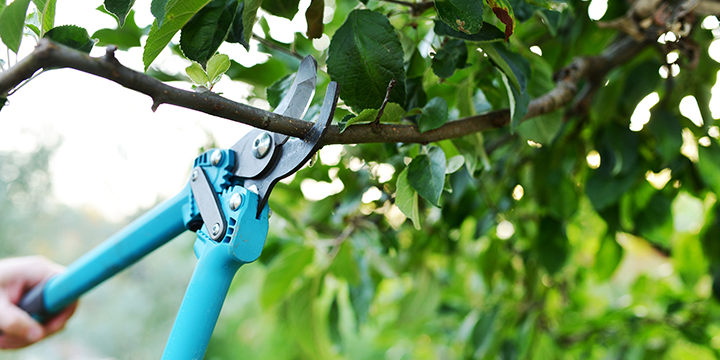
Structural Pruning: This involves selectively removing specific branches to reduce weight, improve balance, and strengthen the tree’s overall form. An ISA Certified Arborist can reduce a tree’s canopy by up to 25 percent in a single session without triggering a starvation response.
Crown Reduction: When a tree genuinely needs to be made smaller, crown reduction uses proper cuts at lateral branches that are large enough to assume the lead role. The tree maintains its natural shape while becoming more compact.
Deadwood Removal: Often, the branches that homeowners are most concerned about (the ones that look like they might fall) are dead or dying wood that can be safely removed without affecting the living canopy at all.
When Removal Is the Better Option
In some cases, a tree has simply outgrown its location. It may be too close to a structure, interfering with utilities, or posing a genuine safety risk that cannot be managed through pruning alone.
In these situations, an honest assessment from an ISA Certified Arborist might conclude that removal and replacement with a more appropriate species is the better long-term solution. This is not a failure. It is responsible tree management. Planting the right tree in the right place, with the right mature size in mind, prevents the cycle of topping entirely.
How to Recognize a Topped Tree
If you are purchasing a home in the DFW area, knowing how to spot a previously topped tree can help you plan for future maintenance or removal costs. Look for:
- Multiple shoots growing from the ends of thick, stubby branches
- A dense, bushy canopy that looks unnaturally thick at the top
- Visible decay at old cut points
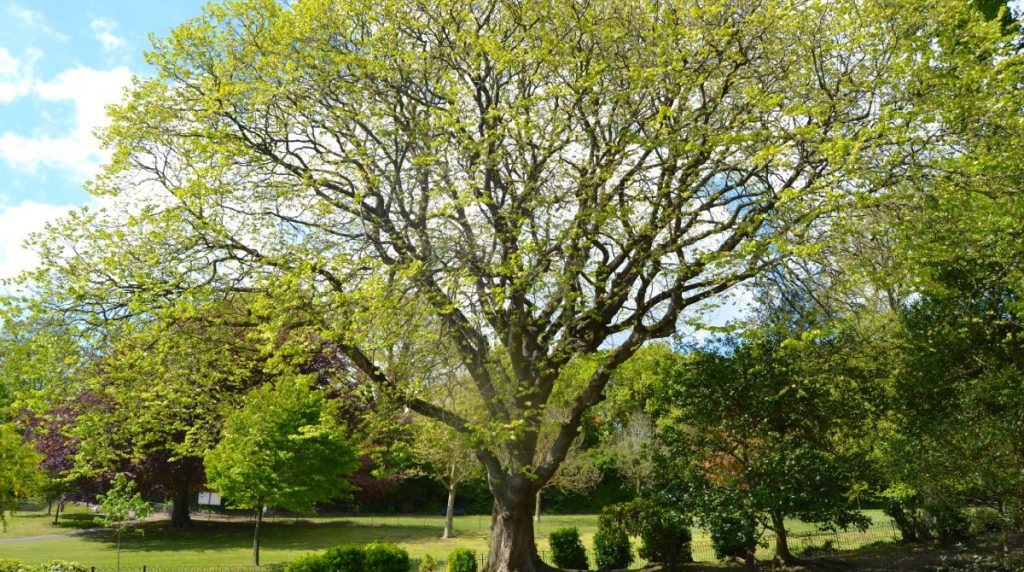
- A flat or rounded canopy shape that does not match the species’ natural form
- Cracks where heavy regrowth is pulling away from weakened attachment points
A home inspection may not cover tree health, but an ISA Certified Arborist can assess whether a previously topped tree is structurally sound or a liability waiting for the next storm.
The Bottom Line
Topping is a quick fix that creates slow, expensive, and sometimes dangerous long-term problems. North Texas trees face enough challenges with our extreme heat, clay soils, drought cycles, and severe storms. Adding the stress of topping to that list is a recipe for decline.
If you are considering reducing the size of a tree on your property, consult with an ISA Certified Arborist before making any cuts. The right approach can give you everything you want (safety, clearance, a manageable canopy) without destroying the tree’s health or increasing your storm risk.
TreeNewal’s team of ISA Certified Arborists serves homeowners across Dallas-Fort Worth, including Southlake, Argyle, Flower Mound, Denton, Fort Worth, and surrounding communities. To schedule a consultation about your trees, contact us here or call 469-754-9014.
You May Also Like