Date March 26, 2026
Category
Crepe myrtles are among the most beloved trees across North Texas. Their vibrant summer blooms, graceful form, and low-maintenance reputation make them a fixture in yards throughout Dallas-Fort Worth. But over the past two decades, a growing threat has been quietly spreading through DFW neighborhoods — crepe myrtle bark scale (CMBS).
If you’ve noticed unusual white or grayish patches on the bark of your crepe myrtle, or if your once-beautiful tree is covered in a sticky, black residue, bark scale may be the culprit. The good news? With the right knowledge and timely action, you can protect your trees and restore them to full health.
In this comprehensive guide, our ISA Certified Arborists break down everything North Texas homeowners need to know about crepe myrtle bark scale — from identification to treatment to long-term prevention.
What Is Crepe Myrtle Bark Scale?
Crepe myrtle bark scale (Acanthococcus lagerstroemiae) is an invasive insect pest originally from Asia. It was first discovered in the United States in 2004 when a landscape company in Richardson, Texas — right here in the DFW Metroplex — brought a sample to a local nursery. Since that initial discovery, CMBS has spread rapidly across Texas and throughout the southeastern United States.
Unlike many common tree pests, crepe myrtle bark scale feeds primarily on the bark, branches, and twigs of crepe myrtles rather than their leaves. As a type of soft scale insect, it attaches itself to the tree, feeds on nutrient-rich sap from the phloem layer, and produces a sugary waste called honeydew. This honeydew then becomes a breeding ground for black sooty mold, the telltale dark film that most homeowners notice first.
CMBS is now one of the most significant crepe myrtle bark diseases in Texas, and DFW sits at the epicenter of its spread. Understanding this pest is the first step toward keeping your trees healthy.
How to Identify Crepe Myrtle Bark Scale
Early detection is critical when it comes to bark scale on crepe myrtle. The sooner you catch an infestation, the easier and less expensive it is to treat. Here’s what to look for:
Visual Signs of CMBS
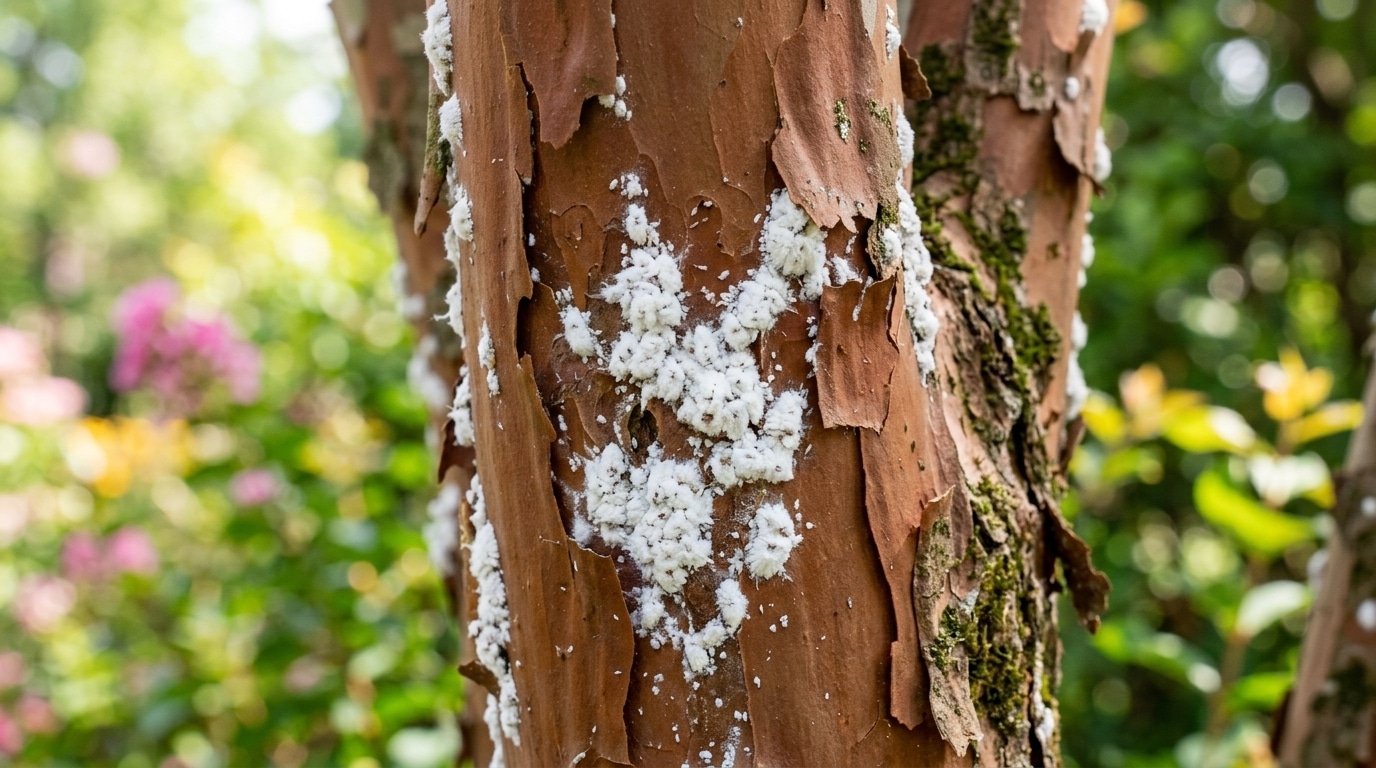
- White or gray felt-like patches on the bark of trunks, branches, and twigs. These are the adult female scale insects covered in a waxy, protective coating.
- Black sooty mold covering the trunk, branches, or even nearby surfaces like sidewalks and patio furniture. This mold grows on the sticky honeydew the scales produce.
- Pink or reddish eggs visible beneath the white waxy covering of adult females. Each female can produce 60 to 250 eggs.
- Reduced blooming — infested trees often produce fewer and smaller flower clusters than healthy crepe myrtles. If you’ve been wondering why your crepe myrtle isn’t blooming, bark scale could be the reason.
The “Pink Crush” Test
One of the most reliable ways to confirm crepe myrtle bark scale is the crush test. Gently press on one of the white patches with your fingernail or a small tool. If it releases a pinkish or reddish fluid, you have a confirmed CMBS infestation. This “pink blood” distinguishes bark scale from other white substances on crepe myrtle bark, like lichen or powdery mildew.
CMBS vs. Other Crepe Myrtle Issues
It’s easy to confuse crepe myrtle bark scale with other common problems. Here’s how to tell the difference:
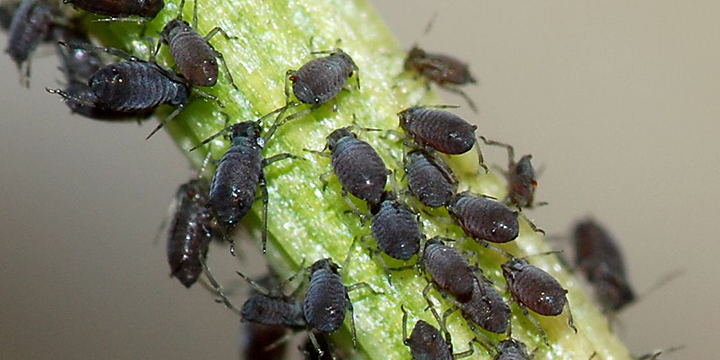
- Sooty mold from aphids: Aphids feed on leaves and cause sooty mold primarily on foliage and surfaces below the canopy. CMBS feeds on bark and causes sooty mold directly on trunks and branches.
- Powdery mildew: Appears as a white, powdery coating on leaves and new growth — not on bark.
- Lichen: Gray-green crusty growths on bark that are harmless and don’t crush pink.
- Natural bark peeling: Crepe myrtles have naturally exfoliating bark that peels in thin layers. This is normal and healthy, it’s one of the tree’s most attractive features.
Understanding the CMBS Life Cycle
Knowing the bark scale life cycle helps you time treatments for maximum effectiveness.
Overwintering (November–March): CMBS overwinters as nymphs (immature insects) and eggs protected inside the white, felt-like ovisacs (egg capsules) attached to bark. They survive North Texas winters in bark crevices and branch crotches.
Spring Emergence (April–May): As temperatures warm and your crepe myrtle leafs out in spring, tiny pink crawlers hatch from the eggs. These crawlers are the mobile stage — they spread along branches and to nearby trees before settling down to feed. This is a critical treatment window.
Summer Generations (June–September): In North Texas (USDA Zone 8), two to three generations of CMBS can occur per year. Each generation follows the same cycle: crawlers settle, feed, mature into adults, mate, and produce a new batch of eggs. Populations can explode during warm summer months.
Fall Decline (October–November): As trees go dormant and temperatures drop, scale activity slows. However, the overwintering nymphs and egg masses remain on the bark, ready to start the cycle again the following spring.
How Crepe Myrtle Bark Scale Damages Your Trees
While crepe myrtle bark scale rarely kills an otherwise healthy tree directly, it can cause significant damage over time:
- Sap depletion: Scale insects continuously feed on your tree’s nutrient-rich phloem sap, weakening it and reducing its overall vigor.
- Sooty mold buildup: The honeydew they excrete supports thick layers of black sooty mold. While sooty mold itself doesn’t directly infect the tree, heavy coatings can block sunlight from reaching bark surfaces and reduce the tree’s aesthetic appeal dramatically.
- Reduced flowering: One of the most noticeable effects. Infested crepe myrtles produce significantly fewer and smaller blooms — a heartbreaking change for any homeowner who planted them for their spectacular summer flowers.
- Increased stress: The combined effects of sap loss and secondary mold growth make trees more vulnerable to other diseases and environmental stressors like the intense heat and drought North Texas is known for.
- Aesthetic degradation: Heavily infested trees with extensive sooty mold can look dead or dying, even though the tree may still be alive.
Treatment Options for Crepe Myrtle Bark Scale
The good news is that CMBS is treatable. Here are the most effective approaches, from DIY methods to professional-grade solutions:
Mechanical Removal (Washing and Scrubbing)
For light infestations, physical removal can make a meaningful difference. Using a soft brush or sponge with warm, soapy water (one tablespoon of dish soap per gallon), scrub the trunk and accessible branches to remove scale insects and sooty mold. Pay special attention to bark crevices, branch crotches, and the undersides of branches where scales tend to cluster.
This method won’t eliminate the infestation entirely, but it reduces the population and allows follow-up treatments to work more effectively. It’s best done in late winter before spring emergence.
Systemic Insecticide Soil Drench (Most Effective)
Soil-applied systemic insecticides are currently the gold standard for treating crepe myrtle bark scale. These products are absorbed by the tree’s roots and transported throughout the entire canopy, reaching scales even in the highest branches that sprays can’t easily reach.
The most effective active ingredients include:
- Dinotefuran — provides the fastest uptake and is considered the most effective single treatment for CMBS
- Imidacloprid — widely available to homeowners and effective when applied at the right time
- Clothianidin and Thiamethoxam — additional neonicotinoid options used in professional applications
Best timing: Apply soil drenches between late March and May, as trees are actively leafing out and can transport the insecticide upward through their vascular system. Treatments applied during dormancy are ineffective because the tree isn’t actively moving water and nutrients.
Contact Insecticide Sprays (Crawler Targeting)
Contact insecticides are most effective when timed to coincide with crawler emergence — typically late April through May for the first generation and again in late summer for subsequent generations.
A combination of bifenthrin with 2% horticultural oil is effective against the mobile crawler stage. The oil helps penetrate the waxy coating that protects settled scales. However, contact sprays are less practical for large trees and must be timed precisely to target the brief crawler window.
Horticultural Oil (Winter Treatment)
During the dormant season, horticultural oil can be applied at a higher rate to smother overwintering nymphs. This is a good supplemental treatment when combined with a spring systemic drench. Focus on thorough coverage of the trunk, branch crotches, and any areas where scales are visible.
Biological Control (Nature’s Helpers)
One of the most encouraging developments in CMBS management has been the natural response from beneficial predators. The twice-stabbed lady beetle (Chilocorus stigma) — a small black ladybug with two red spots — has proven to be a voracious consumer of bark scale insects. Both the adult beetles and their larvae feed heavily on scales.
If you notice these beneficial insects on your crepe myrtles, leave them alone! Their larvae look very different from the adults (spiny and dark-colored), so don’t mistake them for pests. In some North Texas communities, lady beetle populations have helped naturally suppress CMBS numbers over time.
When to Treat for Crepe Myrtle Bark Scale in North Texas
Timing is everything when it comes to effective bark scale management. Here’s a seasonal treatment calendar for DFW homeowners:
Late Winter (Feb–Mar): Scrub trunks with soapy water to remove overwintering scales. Apply dormant-rate horticultural oil.
Early Spring (Late Mar–May): Apply systemic soil drench (dinotefuran or imidacloprid). This is the most critical treatment window.
Late Spring (May–Jun): Monitor for first-generation crawlers. Apply contact sprays if needed.
Summer (Jul–Sep): Watch for second and third-generation crawlers. Reapply contact sprays if populations persist.
Fall (Oct–Nov): Inspect trees for overwintering scale. Note severity to plan next year’s treatment strategy.
Prevention Tips for North Texas Homeowners
Preventing a crepe myrtle bark scale infestation is far easier than treating one. Here are proven strategies to protect your trees:
Inspect Before You Buy
The most common way CMBS spreads to new properties is through infested nursery stock. Before purchasing a crepe myrtle from any garden center or nursery, carefully inspect the trunk, branches, and twigs for any white patches, sooty mold, or signs of scale insects. Even a single female scale or egg sac constitutes an infestation.
Plant in Full Sun
Research has consistently shown that crepe myrtles planted in full sun have smaller and less severe bark scale infestations compared to those growing in partial shade. Shaded trees also tend to support more crawlers, accelerating population growth. Always choose a sunny location when adding crepe myrtles to your landscape.
Maintain Overall Tree Health
Healthy, well-maintained trees are better equipped to tolerate and recover from pest infestations. This means:
- Proper pruning — avoid “crepe murder” (severe topping) and follow correct pruning techniques to maintain structural integrity and airflow
- Adequate watering — especially during North Texas summers when drought stress makes trees more vulnerable
- Appropriate fertilization — feed your crepe myrtles based on soil conditions to support vigorous growth
- Proper mulching — maintain a 2–3 inch layer of organic mulch around the base (avoiding contact with the trunk) to retain moisture and regulate soil temperature
Treat Neighboring Trees Too
CMBS crawlers can spread to nearby crepe myrtles, so if you find an infestation on one tree, inspect and consider treating all crepe myrtles within close proximity — even if they appear healthy. A proactive approach prevents the pest from simply migrating from treated trees to untreated neighbors.
When to Call a Professional Arborist
While mild CMBS infestations can often be managed by homeowners, there are situations where professional help makes a real difference:
- Large or mature trees where reaching upper branches for inspection and treatment is impractical
- Severe infestations with heavy sooty mold coverage and significant decline in tree health
- Multiple infested trees across your property requiring a coordinated treatment plan
- Uncertainty about diagnosis — a certified arborist can confirm whether you’re dealing with CMBS, aphids, another scale species, or a different issue entirely
- Recurring infestations that don’t respond to DIY treatments, which may indicate timing or application issues
At TreeNewal, our ISA Certified Arborists have extensive experience diagnosing and treating crepe myrtle bark scale across Dallas-Fort Worth. We develop customized treatment plans based on the severity of your infestation, the size and number of your trees, and your long-term landscape goals.
Protect Your Crepe Myrtles — They’re Worth It
Crepe myrtles have earned their place as one of North Texas’s most iconic landscape trees. With lifespans that can stretch 50 years or more, they’re a long-term investment in your property’s beauty and value. Crepe myrtle bark scale is a serious threat, but it’s one you can overcome with vigilance, timely treatment, and the right expertise.
Don’t let CMBS rob your trees of their stunning summer blooms. Whether you’re dealing with a confirmed infestation or simply want a professional inspection for peace of mind, our team is here to help.
You May Also Like